
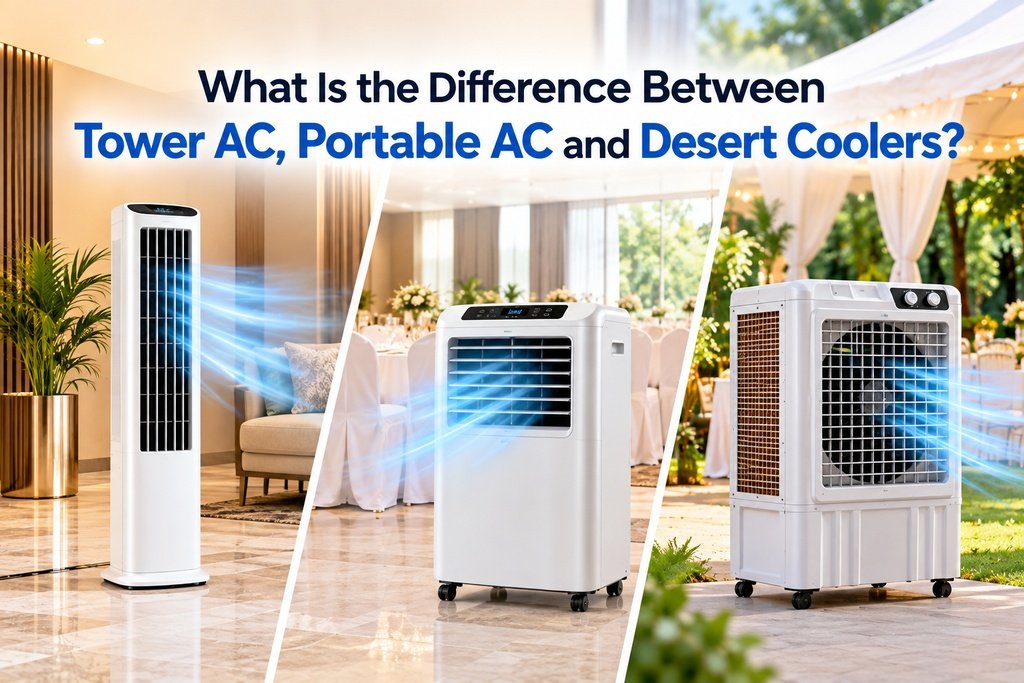
Choosing the right cooling appliance can make a significant difference to your comfort, electricity bills, and indoor environment during hot weather. However, with options such as tower air conditioners, portable ACs, and desert coolers available, deciding which one suits your space can be confusing. Each appliance works differently and offers specific advantages depending on room size, ventilation, humidity, and budget. Understanding these differences helps you avoid spending money on a product that does not meet your needs. UAC Tower helps consumers explore cooling solutions for different spaces and requirements. Whether you need powerful cooling for a bedroom, flexible cooling for a rented apartment, or an economical option for a well-ventilated room, this guide explains how tower ACs, portable ACs, and desert coolers compare in terms of performance, installation, maintenance, and running costs.
1. What Is a Tower AC?
A tower AC is a tall, vertical air-conditioning unit designed to provide cooling without occupying as much floor space as some traditional air-conditioning arrangements. The term can refer to different product designs, so it is important to check whether a model is a complete air conditioner or another type of cooling appliance.
Unlike an evaporative cooler, a conventional tower air conditioner uses a refrigeration cycle to remove heat from indoor air. Depending on its design, it may require an outdoor unit, suitable installation, and a proper drainage arrangement.
Key advantages include:
- Effective cooling when correctly sized for the room.
- A vertical design that can suit modern interiors.
- Temperature control and additional features on supported models.
A tower AC may be suitable for people who want air-conditioned comfort without choosing a conventional wall-mounted indoor unit.
2. What Is a Portable AC?
A portable AC is a movable air conditioner that generally stands on the floor and cools a room using a refrigeration system. Most single-hose models need an exhaust hose connected to a window or another suitable outlet to release hot air outdoors.
Portable ACs are useful where permanent air-conditioner installation is difficult or restricted. However, they still need an appropriate power supply, ventilation, and space for the exhaust arrangement.
Key benefits include:
- Easier relocation compared with permanently installed AC systems.
- No conventional outdoor condenser unit for most single-unit models.
- Temperature control and dehumidification on many models.
Keep in mind that portable ACs can be noisy and may occupy valuable floor space. Their cooling performance also depends on room size, insulation, and exhaust setup.
3. What Is a Desert Cooler?
A desert cooler is an evaporative cooling appliance that uses water and airflow to cool the surrounding environment. A fan draws air through water-saturated cooling pads, lowering the air temperature through evaporation.
Desert coolers generally work best in hot, dry climates where the air has enough capacity to absorb additional moisture. In humid conditions, their cooling effectiveness decreases, and the added moisture may make the room feel uncomfortable.
Common advantages include:
- Usually lower electricity consumption than air conditioners.
- No refrigerant-based cooling system.
- Fresh-air circulation when used with suitable ventilation.
- Water-based cooling that can be economical in dry weather.
For effective performance, maintain water levels, clean the cooling pads, and provide adequate ventilation.
4. Tower AC vs Portable AC vs Desert Cooler
The main difference lies in how each appliance cools the air and the conditions in which it performs best.
Feature | Tower AC | Portable AC | Desert Cooler |
Cooling method | Refrigeration | Refrigeration | Water evaporation |
Installation | Depends on model | Usually needs exhaust setup | Generally simple |
Portability | Model-dependent | Usually movable | Usually movable |
Electricity use | Generally higher than coolers | Generally higher than coolers | Generally lower |
Humid weather | Suitable if correctly sized | Suitable if correctly sized | Less effective |
Best suited for | Air-conditioned indoor comfort | Rooms needing flexible installation | Hot, dry, ventilated spaces |
Actual performance, power consumption, and costs vary by model and usage.
5. Which Cooling Appliance Is Best for Your Room?
Your choice should depend on the climate, room conditions, and cooling expectations.
- For bedrooms: A suitably sized AC may be preferable when consistent temperature control is important.
- For rented homes: A portable AC may work where permanent installation is restricted, provided a suitable exhaust outlet is available.
- For large, dry, ventilated areas: A desert cooler can offer economical cooling with adequate airflow.
- For humid cities: An AC is generally more effective than an evaporative cooler because it can also remove moisture from indoor air.
Before buying, check the room area, sunlight exposure, ceiling height, ventilation, appliance capacity, and available electrical supply.
6. Electricity Consumption and Maintenance
Electricity costs depend on rated power, operating hours, local tariffs, and cooling conditions. ACs typically consume more electricity than desert coolers, although the exact difference varies considerably.
To make an informed comparison, check each product’s rated wattage and estimate daily usage. For example, an appliance rated at 1,000 watts running for five hours uses approximately 5 kWh of electricity, before accounting for variations in actual operation.
Maintenance also matters. ACs require filter cleaning and periodic servicing, while portable ACs may need condensate management. Desert coolers need regular cleaning of the water tank and pads to help prevent odours and buildup.
Conclusion
Understanding the difference between a tower AC, portable AC, and desert cooler helps you select a cooling solution that matches your room, climate, and budget. ACs are generally better for controlled cooling in humid conditions, portable models offer installation flexibility, and desert coolers are economical options for hot, dry environments with good ventilation. UAC Tower encourages consumers to compare specifications, energy consumption, and maintenance needs before choosing a product. Review your cooling requirements carefully to find a solution that delivers comfort and practical value throughout summer.
Looking for the right cooling solution? Explore available options from UAC Tower and compare product specifications to make a choice that suits your space and everyday needs.
Frequently Asked Questions
1. Which is better: a tower AC or a desert cooler?
A tower AC is generally better when you need controlled cooling, particularly in humid conditions. A desert cooler is usually more economical to operate and works best in hot, dry climates with sufficient ventilation.
2. Does a portable AC require a window?
Most portable ACs require an exhaust hose connected to a window or another suitable outdoor outlet. Without proper exhaust ventilation, hot air can return to the room and reduce cooling effectiveness.
3. Which appliance consumes less electricity?
Desert coolers generally consume less electricity than air conditioners because they use a fan and water-based evaporation rather than a refrigeration compressor. Actual consumption depends on the specific model and usage.
4. Can a desert cooler work in humid weather?
A desert cooler can circulate air in humid weather, but its evaporative cooling performance is reduced. The additional moisture may also make the room feel uncomfortable, so an air conditioner is often more suitable.
5. Is a portable AC suitable for a rented apartment?
Yes, a portable AC can be useful in rented accommodation where permanent installation is difficult. However, check window access, exhaust requirements, electrical capacity, noise levels, and the landlord’s rules before purchasing.